 Sign In


 Ubersuggest
  AnswerThePublic

Key Takeaways
- AI search has spread beyond Google. ChatGPT, TikTok, and YouTube are now regular search platforms for users.
- 44 percent of sites have seen flat or declining traffic since AIOs launched.
- Zero-click will make featured snippets, AI Overviews, brand mentions, and conversational content key.
- Brand mentions have serious SEO value. As much as 78 percent of marketers consider them a key visibility factor in 2025.
- Winning in search now means adopting a Search Everywhere Optimization strategy that spans AI tools, video, social, and traditional search engines.
- See the full report on the NP Digital website.
If you’re not paying attention to search trends, you’re already falling behind. And in 2025, falling behind means losing visibility, traffic, and revenue, often to the tune of thousands (or millions) of dollars.
Some marketing pros and SEOs still haven’t learned this lesson. Maybe they don’t have the budget to invest in video, or a specific algorithm update doesn’t move the needle enough to get their attention.
And there are still CMOs who think AI doesn’t pose a big risk to their strategies, and other C-suite members continue to ignore the sunk cost fallacy.
Trends matter, though. Staying ahead of the curve matters. And right now, that curve is moving fast. Miss one core update or shift in user behavior, and you’re already behind. A single minute’s hesitation could set you back months.
The SEOs who are proactive, not responsive, are the ones winning big.
Take AI Overviews and Search Everywhere Optimization, for example. These trends have taken off and will continue to define the future of search. Let’s look at these and other big trends dominating search.
Our Methodology
We talked to two groups to better understand how AI and other trends impacted how people used search; in one survey, we spoke to 1,000 American adults with general questions. In addition, we reached out to 600 American full-time professionals who worked in marketing, market research, sales, and advertising.
AI Overviews Take Center Stage After Some Growing Pains
Google’s AI Overviews (AIOs) had a rocky start, but they’re not going anywhere.
After rolling out globally in May 2024, AIOs quickly took a spot in all kinds of search results, but not without hiccups; in our survey of general adults, users got answers faster, but they weren’t always better. Almost 25 percent of users reported major errors. Over 50 percent said their biggest issue was just flat-out inaccuracy, to the point of danger.

That said, most users (almost 75 percent) haven’t noticed major problems. And despite some early skepticism, AIOs are already shaping how people consume content in search, with some fears that web traffic will fall off as the search giant continues its efforts to keep users on the SERP instead of clicking through.


From a traffic perspective, our survey showed 44 percent of marketers reported decreased web traffic since AIOs launched. With that said, 48 percent saw a revenue boost from ads and affiliate links. It’s a strong signal that AIOs are about more than visibility changes; they are changing the rules of the game.

So, how do you get your content to show up in AIOs? The structure matters. No matter what you (or your content team) are writing, start by focusing on:
- Clear, concise answers high on the page
- Use of headings to mirror search queries
- Schema markup that clarifies context
- High E-E-A-T (experience, expertise, authoritativeness, and trustworthiness) signals
- A conversational tone (yes, even in technical content)
And don’t forget freshness. AIOs pull recent, relevant content first.

Showing up in AI Overviews is more than just bragging rights. It’s taking up a valuable position in the new top-of-SERP real estate. Ignoring AI SEO and failing to optimize for it just gives visibility away.
How Marketers Can Work Around Zero-Click Search
AI Overviews are part of the growing wave of zero-click searches. In a zero-click world, users get their answers directly on the SERP; no further reading necessary. Featured snippets, local packs, people-also-ask boxes, and AIOs have all made organic traffic harder to win.
But that doesn’t mean you’re out of options.
Marketers are adaptable, and this development is no exception. Forty-three percent of marketers have changed their content strategies to respond to this shift.
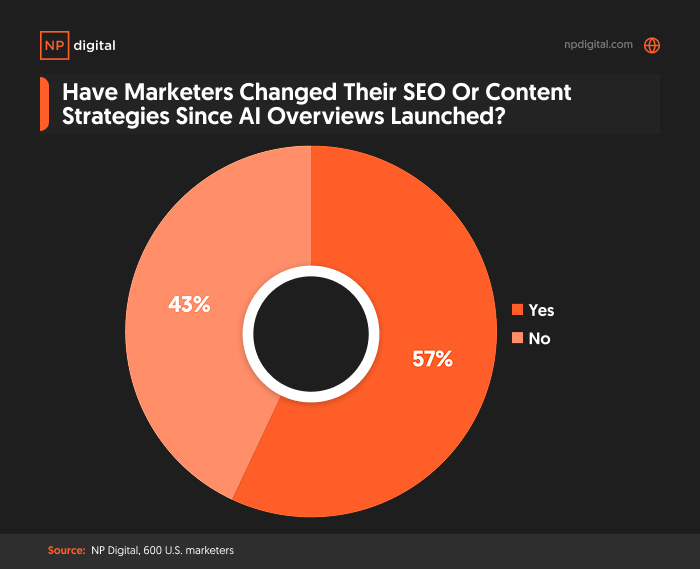
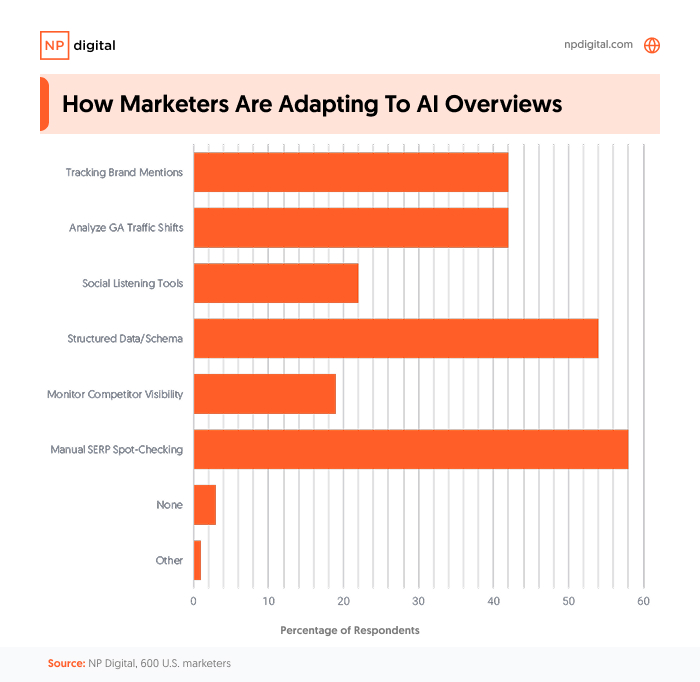
Their focus now? Clear, scannable content that answers questions upfront. Structured data, brand mentions, and conversational formats are more important than ever.
The goal isn’t just to rank. It’s to show up in the spots users see first.
Google’s New AI Mode Is Here
Google’s AI Mode officially rolled out to all U.S. users in May 2025, and it’s already changing how people interact with search.
AI Mode flips the switch on how Google displays search results. Instead of the classic link list, users now see AI-generated summaries by default, especially for complex or open-ended queries.
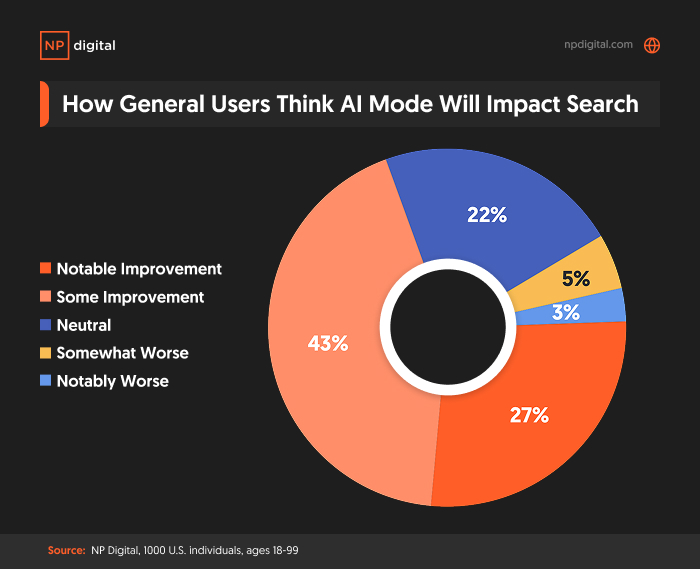
According to Google, the goal is to “make search smarter and more helpful with generative AI.” Their idea is to offer a faster path to answers, context, and decision-making.
The reaction? Cautiously optimistic.
Our survey shows over 57 percent of marketers already knew about AI Mode’s debut. Of those, 74 percent believed it could improve the overall search experience, with nearly a third expecting “notable” usability improvements.
But user experience isn’t the only concern. It’s a signal to marketers, too. AI Mode will likely increase zero-click results and shift keyword targeting strategies. That will push creators to optimize for summaries, not just snippets.
According to Nikki Brandemarte, Sr. SEO Strategist at NP Digital, one of the best ways to optimize for AI Mode is to focus on tactics we’ve known work for a while, but even more.
Lock in on featured schema, prioritize context-rich introductions, and use conversational formatting. Freshness and clarity win the day, too, so regularly revisit your content and adjust it. Or write something new and authoritative. That’s especially important, since AI Mode can now source information published within the last 24 hours.

Brandemarte explains: “[AI Mode] is designed for users to ask more complex, multi-part questions that go beyond basic information provided by traditional AI overviews. These more comprehensive, better-structured answers expand on AIOs and overlap.”
The bar is higher. But if your content is clear, helpful, and well-structured, AI Mode can amplify your visibility (not erase it).
AI Search Is Spreading as a Concept
AI-powered search didn’t stop with Google, and it’s not going to, either. We’re now in a landscape where search is becoming a feature as opposed to a destination.
AI search is everywhere: ChatGPT, Microsoft Copilot, and even AI-driven tools built into apps you open every day, like Reddit, TikTok, or YouTube. Thirty percent of our surveyed general online users now turn to ChatGPT or SearchGPT at least 10 times a week.

On the marketer side, 74 percent actively watch ChatGPT, and 41 percent track Microsoft Copilot.

That shift is actively reshaping user behavior. AI summaries are now the first impression. Thirty-one percent of users trust AI summaries more than traditional search results.
Regardless of your thoughts on AI search’s efficacy and accuracy, it’s a trend you can’t ignore.
How to Minimize Risk and Stay Visible
If your brand isn’t visible across multiple ecosystems, you’ll be left behind. That’s the ethos behind Search Everywhere Marketing, and we take it very seriously.
Right now, only 51 percent of our surveyed marketers are actively tracking their brand visibility in AI search platforms. This is despite the fact that out of our surveyed marketers, brand visibility tracking was seen as the most popular way it would impact search strategy in the next year (45 percent). That means that there’s a shift many marketers know is coming, but aren’t prepared for.

What can you do if you’re in that group? Well, here’s how to catch up:
- Monitor traffic shifts with Google Analytics and Search Console (GSC). They’re still your first red flags.
- Set up trend logging to detect drops or spikes in branded queries.
- Use social listening tools to track brand mentions in places like AI Overviews and conversational search results.
- Build brand mentions through PR and content syndication. More than three-fourths of our surveyed marketers say brand mentions are vital for SEO, so this is no longer optional.
- Lean into conversational content. Google and AI platforms favor content that answers naturally phrased questions.
- Finally, invest in structured data and featured schema to improve your odds of being cited directly in AI results.
The bottom line is that visibility isn’t about blue links alone anymore. Your content has to be everywhere that people ask questions, even if they never click.

Marketers Need to Find Ways to Start AI Visibility Tracking
If AI-driven search is the future, visibility tracking is how you future-proof your content.
Right now, most AI platforms don’t offer direct analytics. You won’t find a neat report in Google Search Console labeled “AIO Clicks.” Even though people have asked (repeatedly).
That’s a problem. As AI summaries and chat-based search tools like ChatGPT take up more screen space, marketers are beholden to something like a vibes-based approach.
As we noted above, only 51 percent of marketers track brand visibility in AI search. The rest are either exploring tools (38 percent) or not tracking at all. That’s a big visibility gap, but it’s also where you can find a competitive advantage:
Until native tools catch up, marketers have a blend of tactics. You can try to monitor traffic shifts in GA and GSC for early signals and use social listening platforms to track branded mentions and snippets.
Savvy users of platforms like Semrush can use it to help track AIO appearances, too. For priority keywords, log trends manually if necessary (even via screenshots).
AI visibility isn’t going away. Don’t neglect it.

Along with existing SEO tools and program suites, there are other products that are designed to meet the specific needs of the AI space. Profound is an AI search optimization tool designed to track important AI-related performance metrics like AI search such as sentiment, citation frequency, and AI share of voice.

Source: (Image Source)
Finally, monitor referral traffic from LLMs like ChatGPT or Perplexity. Currently, 24 percent of marketers have seen consistent traffic from those sources.
Google is still important (as our own VP of SEO Nikki Lam attests), but we’re entering a whole new world of attribution.
Google vs. LLM Referral Traffic: What’s Coming Out on Top?
For the first time in decades, Google isn’t the only game in town for search-driven traffic.
LLMs like ChatGPT, Perplexity, and Claude have started to chip away at Google’s dominance. Given that nearly a third of users say they use ChatGPT or SearchGPT per week, and how many marketers see consistent referral traffic, the shift is subtle, but it’s happening: It’s not just curiosity. It’s a behavior change.
Ready for something even more telling? As much as 34 percent of marketers believe AI tools will account for 25 to 50 percent of search activity within the next year. Some think the number could go even higher.
Keeping your brand discoverable as LLMs grow is absolutely vital, but it’s not as complex as you’d think.
We’ve touched on many of the tactics already: Focus on meeting conversational queries with clear, fact-rich content. Monitor your referral traffic from known LLM browsers and tools.
Most importantly, diversify your strategy. Think beyond “ranking” and more about being referenced.
Short-Form and Conversational Content Are at a Premium
In a world of AI summaries and zero-click search results, brevity is everything.
Short-form, conversational content is easier for AI models to parse, summarize, and cite. If your post or article buries the answer in paragraph five, you probably won’t be featured in AI Overviews (or any other generative snippets).
Tactics like including FAQs, key takeaways, and “too long, didn’t read (TL;DR)” sections are almost mandatory. AI tools seek out and prioritize structured, scannable, and intent-matching text blocks.
Nearly 42 percent of marketers already optimize new content for conversational queries, and 58 percent are refreshing their existing content to meet these new standards.
But keep one thing in mind: This isn’t about “dumbing things down.” Instead, it focuses on getting to the point—fast—and in a way that mimics how users ask questions out loud.
What can you do to help? Use headers that sound like real questions. Keep your answers clear and focused. When possible, use schema markup to reinforce the content’s structure.
Our TL;DR? Keep it short, smart, and skimmable if you want to be quoted.
Our Key Takeaways from a recent blog demonstrate a TL;DR approach to sharing information.

Tailoring Your Content to Fit Preferred Platforms
Ranking alone isn’t enough. Your content also needs to fit where your audience is searching.
Depending on your brand and audience, that might look like long-form blog posts to show up in Google, or it could mean creating vertical videos for TikTok. Other solutions could include product explainers on YouTube or visuals to engage Instagram users.
Younger audiences have already begun to shift search behavior. Platforms like TikTok, YouTube, and Instagram are their go-to sources for product discovery, how-tos, and health information. Sixty-seven percent of Gen Z users prioritize Instagram for search, while 62 percent focus on TikTok. As a result, over 63 percent of marketers have already started to optimize or test content for these channels.
How can you keep up?
Start by adapting your message to the format. Use generative engine optimization (GEO) for AI search, vertical video for TikTok and Reels, and snackable visuals for platforms like Pinterest and Instagram.
An overarching strategy that uses different platforms to meet the same goal: Meet your users where they are and speak their language.
Backlinks vs. Brand Mentions: Where Should Marketers Focus?
Backlinks have long been a pillar of SEO and still matter a lot. But the AI-driven, zero-click environment emphasizes and incentivizes brand mentions, too. What’s the difference between them?
- Backlinks are clickable URLs that pass SEO equity.
- Brand mentions are unlinked references to your company or product. Think name-drops in articles, podcasts, and social posts.
Google has hinted for years that brand mentions influence trust and authority. With AI platforms pulling in content and citations differently, those mentions are more valuable than ever.
Seventy-eight percent of marketers in our survey say brand mentions are at least “moderately important” for visibility. Thirty-two percent call them “extremely important” signals.

They’re so important that over 65 percent of marketers are already prioritizing mention-building with PR, guest posts, social campaigns, and influencer outreach.
So, which one should you focus on more? Mentions or links?
Both still matter, but the emphasis or split depends on your niche. E-commerce brands, for example, often see big returns from unlinked mentions in product roundups or reviews. B2B brands may still rely more heavily on authoritative backlinks.
The balance lies in knowing which one to prioritize and when.
Search Engine Optimization Evolves to Search Everywhere Optimization
Let’s be real. Google isn’t the only place your audience is searching anymore. That means traditional SEO—a Google-focused effort—isn’t enough. As we’ve touched on above, what you need now is Search Everywhere Optimization.
The concept is simple, and it’s something many marketers have done for years, if not as a focus: Instead of optimizing for Google’s algorithm alone, make sure your content is discoverable wherever your audience hangs out online.
According to our survey, more than 60 percent of users regularly search on at least one non-Google platform (ChatGPT, Reddit, TikTok).

Meanwhile, 55 percent of marketers say they’re investing in alternative traffic channels like paid social, email, or native ads to counterbalance any potential losses thanks to AI search.
What does this look like in practice?
- Publishing educational content on YouTube and optimizing Shorts
- Creating bite-sized, searchable videos for TikTok and Instagram Reels
- Building credibility with appearances on podcasts and community platforms like Reddit
- Getting cited in AI tools like ChatGPT
- Using email and push notifications to bring users back to you

Remember, we’re not abandoning SEO. We’re expanding our strategy.
FAQs
What are the biggest search engine trends shaping SEO right now?
Some of the biggest trends include AI Overviews, zero-click searches, AI-powered search experiences, conversational search behavior, and the rise of Search Everywhere Optimization across platforms like Google, ChatGPT, YouTube, TikTok, and Reddit.
How are AI Overviews impacting organic search traffic?
AI Overviews are changing how users interact with search results by providing direct answers on the SERP. This reduces clicks to websites in many cases, forcing marketers to focus more on visibility, structured content, and featured placements instead of relying solely on traditional rankings.
What is zero-click search?
Zero-click search happens when users get the information they need directly from the search results page without clicking through to a website. Features like AI Overviews, featured snippets, local packs, and People Also Ask boxes contribute to this trend.
What is Search Everywhere Optimization?
Search Everywhere Optimization is a strategy that focuses on building visibility across multiple platforms where users search for information, including AI tools, social platforms, video platforms, and traditional search engines.
How can businesses stay visible as search evolves?
Businesses can stay competitive by creating structured and conversational content, using schema markup, improving E-E-A-T signals, tracking AI visibility, building brand mentions, and optimizing content for AI-driven search experiences.
Conclusion
AI has turned the world of search completely upside down, and there are still a lot of variables to account for. But that doesn’t mean you can’t proactively start taking steps to position your brand for success.
Last year, we mentioned that content volume isn’t as important as content quality. That’s still true. Keep a regular cadence but focus on shorter, quality content that AI Overviews can pull from.
As more brands rely on AI to help produce content at scale, you can prioritize building your brand with consistent messaging across all channels; that’s Search Everywhere in motion.
If you’re not confident about leveraging these strategies or trends, why not partner with someone who can? Contact the NP Digital team today for a consultation.
Are You Using Google Ads? Try Our FREE Ads Grader!
Stop wasting money and unlock the hidden potential of your advertising.
- Discover the power of intentional advertising.
- Reach your ideal target audience.
- Maximize ad spend efficiency.