 Sign In


 Ubersuggest
  AnswerThePublic

Key Takeaways
- Content repurposing is the process of transforming a piece of existing content into one or more new pieces of content for different platforms. For example, a blog post can become several social media posts, a YouTube video, or a podcast.
- You don’t have to worry about duplicate content issues when repurposing content because you’re reformatting and editing the existing content for new platforms.
- Content repurposing can scale your content production efforts since a single asset can create a dozen posts. It also increases your reach across multiple platforms and maximizes the ROI of your content assets.
- Start the content repurposing process by finding your most popular assets using Google Analytics. Next, decide which platforms are most appropriate and then adapt your content for them. Don’t forget to add platform-specific features like hashtags and optimize your new posts accordingly.
- I’ve had a lot of success repurposing my own content. That includes turning a white paper into a webinar with over 7000 views and an in-depth guide into social media content with 4,700 impressions and a 6.45 percent engagement rate.
What if I said you didn’t need to spend several hours brainstorming social media posts or dedicate the next day to writing a new blog article?
You already have everything you need to meet your publishing schedule and satisfy your audience’s craving for content…you just need to repurpose it.
Content repurposing takes an existing piece of content (like a blog post) and turns it into new content for other channels. The result? You get dozens of new posts for way less effort!
In this article, you’ll learn what content repurposing is, why it’s so powerful, and how to do it.
What is Content Repurposing?
Content repurposing, also known as content recycling, is the practice of reusing and reformatting an existing piece of content for a new platform.
Content repurposing gives new life to old content, helping you reach new audiences and scale your content production efforts.
You can repurpose almost any type of content, including:
- Blog articles
- E-books and whitepapers
- Social media posts
- YouTube videos
- Webinars
- Podcasts
- Infographics and images
- Templates
For example, I can repurpose one of my blog articles into several LinkedIn posts, a TikTok video, and a webinar.
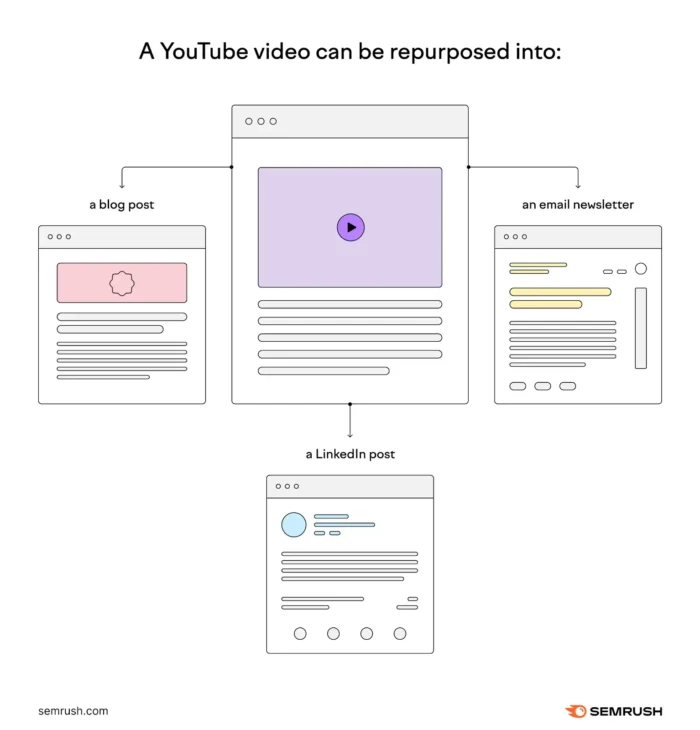
Converting content for a new platform isn’t a copy-and-paste job. Rather than just republishing content, you must adapt it to each channel.
Content Repurposing vs Republishing
If you don’t change your existing content but just publish it on a new channel in full, that’s called content republishing. As you can imagine, it’s not particularly effective.
No one who is doom-scrolling Instagram wants to watch a full-length YouTube video. Professionals on LinkedIn aren’t going to read your 1500-word blog post.
That’s why adapting your content to specific channels is integral to the content repurposing process.
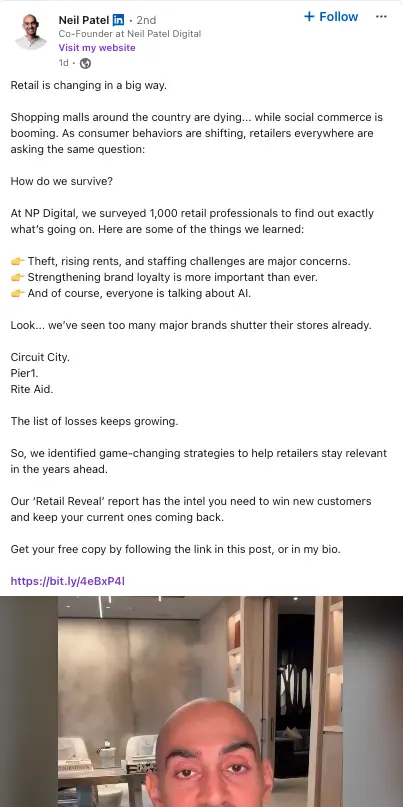
One strategy is to split a large piece of content (like a whitepaper) into smaller pieces and share them on relevant channels. For example, I can adapt the blog’s images for Instagram or share an actionable takeaway with my LinkedIn followers.
Here’s me doing just that with my Retail Reveal guide, distilling an 18-page guide into a single post:
Content repurposing makes your content go so much further. While republishing content in full only yields one additional use, I can create a dozen pieces of new content from a single blog post by repurposing it.
Both republishing and repurposing re-use your existing content. But only repurposing creates something genuinely new and valuable for your audience.
What About Duplicate Content Penalties?
To be fair, this is a very valid concern. Surely, we risk falling foul of Google’s duplicate content rules by repurposing content?
The short answer is no. If we do content repurposing correctly, we’ve got nothing to worry about. We’re tweaking our own content and never reposting something word for word.
Google isn’t that concerned with duplicate content, anyway. It certainly doesn’t penalize you, as John Mueller explains:
“…it’s not so much that there’s a negative score associated with it. It’s more that if we find exactly the same information on multiple pages on the web, and someone searches specifically for that piece of information, then we’ll try to find the best matching page.”
Why Repurpose Content?
There’s more to this strategy than breathing new life into old blog posts. Check out the following benefits of repurposing content:
Increase your reach
Even your most dedicated followers will only consume a fraction of the content you create. Repurposing it into several different forms gives people multiple opportunities to engage with your brand.
It also helps you expand your reach to brand-new audiences.
People on YouTube might care about what you have to say even if they don’t want to read your blog. By turning your blog topics into short, informative videos, you can get your brand in front of a massive new audience.
Maximize the ROI for your content efforts
You put all that effort into creating a killer piece of content; it’s a waste only to use it once. Content repurposing extends the lifecycle of your content, allowing you to squeeze as much value from it as possible.
Scale your publishing efforts
It’s hard to match your audience’s insatiable appetite with net new content alone. A content repurposing strategy lets you continue pushing high-quality, engaging, and informative content to audiences on every channel without having to devote time and effort to create something from scratch every single time.
Improve your SEO
Repurposing content gives you multiple chances to rank in the SERPs. It also helps you adopt a “Search Everywhere” approach to optimization that accounts for the fact people don’t use only Google to find answers anymore. The modern consumer asks AI chatbots, searches on TikTok, or heads to YouTube.
How To Repurpose Content
Convinced you need to repurpose your content? Great! Here’s how to repurpose content and scale your publishing efforts:
Finding Repurposing Opportunities
It’s best to start your content repurposing journey with your top-performing content.
Find them by logging into your Google Analytics account.
Clicking Reports in the left-hand sidebar, then navigate to Life cycle > Engagement > Pages and screens.
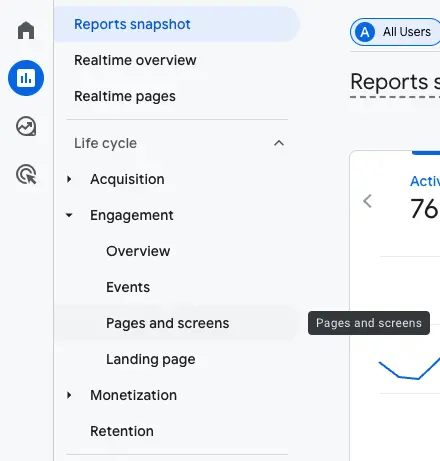
This report gives you engagement KPIs for every page on your site.
Expand the date range to cover the last six months or year to give a fairer reflection of user engagement.
If your blog posts are in a subdirectory like “/blog” or “/news”, enter that into the search bar at the top of the report to narrow down the results.
In my case, it’s “/blog”:

Now, you can sort your posts by views or average engagement to find your most popular posts.

Don’t just focus on blog posts, though. Check out your social media analytics to find top-performing social posts or YouTube Analytics to find your most engaging videos.
However, only some pieces of popular content will be fit for repurposing.
Choose evergreen articles that remain relevant over pieces that cover current events or trending topics. Your repurposed content should stand the test of time.
Identify the Most Appropriate Platform for Repurposing
Once you’ve built a list of your most popular evergreen content pieces and blog posts, it’s time to find the most suitable platform for repurposing.
Only some platforms are going to be a great fit. So, don’t try repurposing every content on every channel.
Start with the channels most similar to your existing piece of content or use one of these proven repurposing methods:
- E-books and whitepapers become blog posts
- How-to guides become social media posts
- Short blog posts become email drip campaigns
- Social media posts turn into newsletters
- Blog post images become social posts
- Webinar clips turn into YouTube videos and TikTok posts
- Long-form videos become podcasts
- Blog post series become webinars
Pay particular attention to channels where you have the largest following or up-and-coming channels on which you want to grow an audience.

For example, I’ve seen great results repurposing YouTube videos and webinars on TikTok — a channel on which I’ve been focused on growing an audience over the last couple of years.
Adapt Your Content To The New Platform
Because we’re repurposing content (not republishing it), we’ll need to adapt our content before posting on new platforms.
That could mean slightly tweaking the language, adding a caption or hashtag, or a complete rewrite.
You can publish a takeaway or piece of advice from a blog post on LinkedIn with just a couple of tweaks. Here’s an example of an NP Digital LinkedIn post that includes steps from my blog on increasing email click-through rates.

But you might need to add transitions, captions, and other visual edits to post a clip from a webinar on TikTok. Just check out the edits my videography team have added to this post:
Make this process as easy as possible by thinking about repurposing when creating original content.
“You can be proactive by planning content elements that naturally translate to other channels,” says Shelby Dias, Content Production Lead,” at NP Digital.
“For example, custom images in a blog post could be repackaged on social media. Unique insights or proprietary data in a blog could be folded into your email marketing. Any content that’s especially helpful, relevant, or unique is likely to get some more mileage when you repurpose it. So it pays to put in the work on the front end to create quality content.”
Refurbish and Republish Older Posts
You don’t always have to change the medium when repurposing your content. You can sometimes refurbish and republish your old content in its original format.
How do you know when to refurbish an old blog post? Here’s the criteria my team uses:
- When it stops ranking well
- When the information is no longer correct or relevant
- If we want to consolidate information from other content into it
So, what does this refurbishment entail?
That’s entirely up to you! You can do a full-blown rewrite or just make edits to sections of the post. You may even want to add an updated section to follow up on the previous data.
Whatever you decide, here are some quick tips to get you started refreshing content:
- Make a list of your blog posts including performance metrics.
- Decide which blog posts are due for an update.
- Prioritize your list based on which updates you think will be most beneficial for your audience.
- Make the necessary updates.
- Share the newly updated article on your social media accounts.
There are several ways to update old content, including:
- Adding new facts or figures
- Incorporating new screenshots
- Discussing a new tool
- Sharing a new opinion
- Combining multiple posts into a single in-depth guide
How I’ve Found Success With Repurposing Content
I love how repurposing content lets me scale my production and expand the reach of my top-performing pieces.
Here are some of the ways I’ve seen success with the strategy:
Example 1: Search Engine Rewind
The Search Engine Rewind is one of the biggest pieces of content we produce at NP Digital. Bursting with reflections on the past year in SEO and predictions for the future, it naturally lends itself to content repurposing.
And boy, do we make this asset go as far as possible.
A summary-style blog post is naturally the first place to start. I covered some of the trends our guide unearthed in detail, giving readers a taste of what they can find in the complete guide. I don’t cover everything to encourage users to download the full report.
The latest version of this post already has over 48,000 impressions in the search and 232 clicks.

We also translated the asset into a series of LinkedIn posts. As you can see, we pared back these posts significantly to cover only the headline trends. We also added platform-relevant optimizations like hashtags.
So far, these posts have:
- 4.4k impressions
- 1.45k clicks
- 1.5k engagements
- 10.62 percent engagement rate
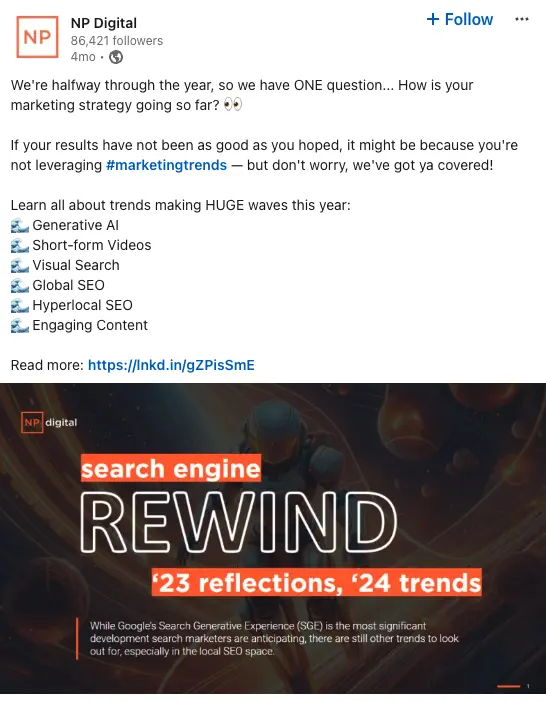
Finally, we turned the report into a webinar where two of my agency’s lead SEOs (Rob and Lindsey) and I fully discuss the findings.
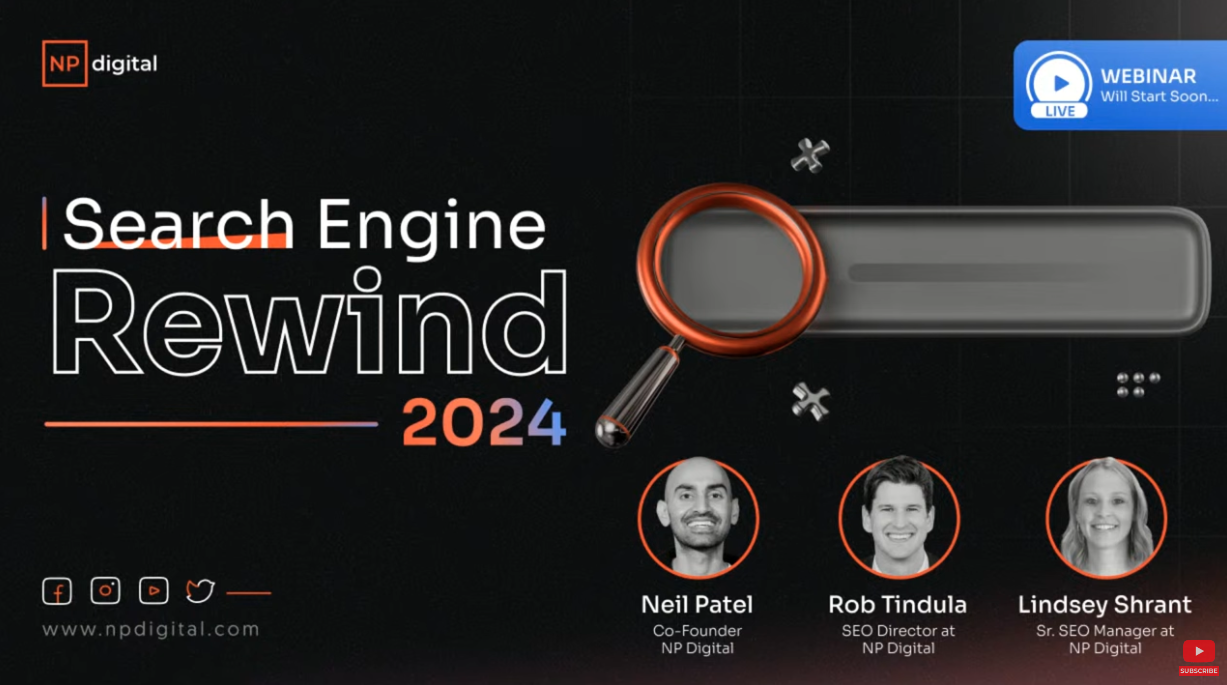
It’s a fantastic addition to the guide and a great way to consume the original downloadable asset. It’s had over 7,000 views so far.
Example 2: Website Migration
Website migration support is one of my agency’s core offerings, so much so that we created an in-depth guide to the process. It guides marketers through the process and also acts as a lead magnet to capture prospective customers.
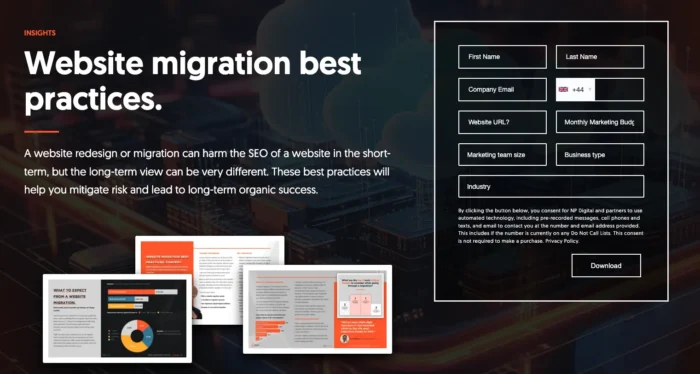
We knew we could make this asset work even harder, though, which is why we summarized it into an informative blog post. The blog isn’t as detailed as the whitepaper, but it provides a handy checklist marketers can use when running a migration.

The blog has gained 250 clicks and 52,600 impressions so far.
Then, we created a series of LinkedIn posts:
One promoted the lead magnet directly:

Another turned some of the guide’s advice into a how-to-style post narrated by our SEO expert, Brittany Werdowatz:

In both these posts, you can see how we’ve tailored the initial asset to LinkedIn by adding hashtags, linking to profile pages, and using emojis.
These posts have 4,700 impressions, 125 clicks, and 349 engagements, with a 6.45 percent engagement rate.
FAQs
What is repurposing content?
To repurpose content means to take a piece of existing content (e.g., blog content, visual content, etc.) and rework it to meet the needs of a different subset of your audience. For example, tweaking a blog post into a more conversational format and then turning it into a podcast or video.
How can I repurpose content?
There are plenty of tried-and-tested methods you can follow to repurpose your content. That includes:
Turning blog posts into podcasts
Turning a white paper or e-book into a blog post
Turning webinar into a YouTube or TikTok video
Using blog post images on social media
Using blog post snippets on social media
What is the benefit of repurposing content?
The greatest benefit of repurposing content is to push your content marketing strategy much further than it would go if you were to create content piecemeal. When repurposing content, you can reach a wider, more diverse audience. You are also able to get more creative in how you market your content.
What is the process of repurposing content?
The content repurposing process will change depending on the asset. In general, though, you should follow this process:
Promote the repurposed content
Identify a piece of high-performing content using web analytics
Choose an appropriate platform to publish the repurposed content on
Reformat the content to align with the new platform. That means making a blog post much shorter for social media, for example, and adding hashtags and other platform-specific features.
Conclusion
Content repurposing makes your assets go so much further. It scales your production, grows your audience, and maximizes your ROI.
So what are you waiting for?
If you have a catalog of content, then start repurposing it immediately. You don’t know how much value is locked away in your blog’s archive until you dig through it.
Are You Using Google Ads? Try Our FREE Ads Grader!
Stop wasting money and unlock the hidden potential of your advertising.
- Discover the power of intentional advertising.
- Reach your ideal target audience.
- Maximize ad spend efficiency.